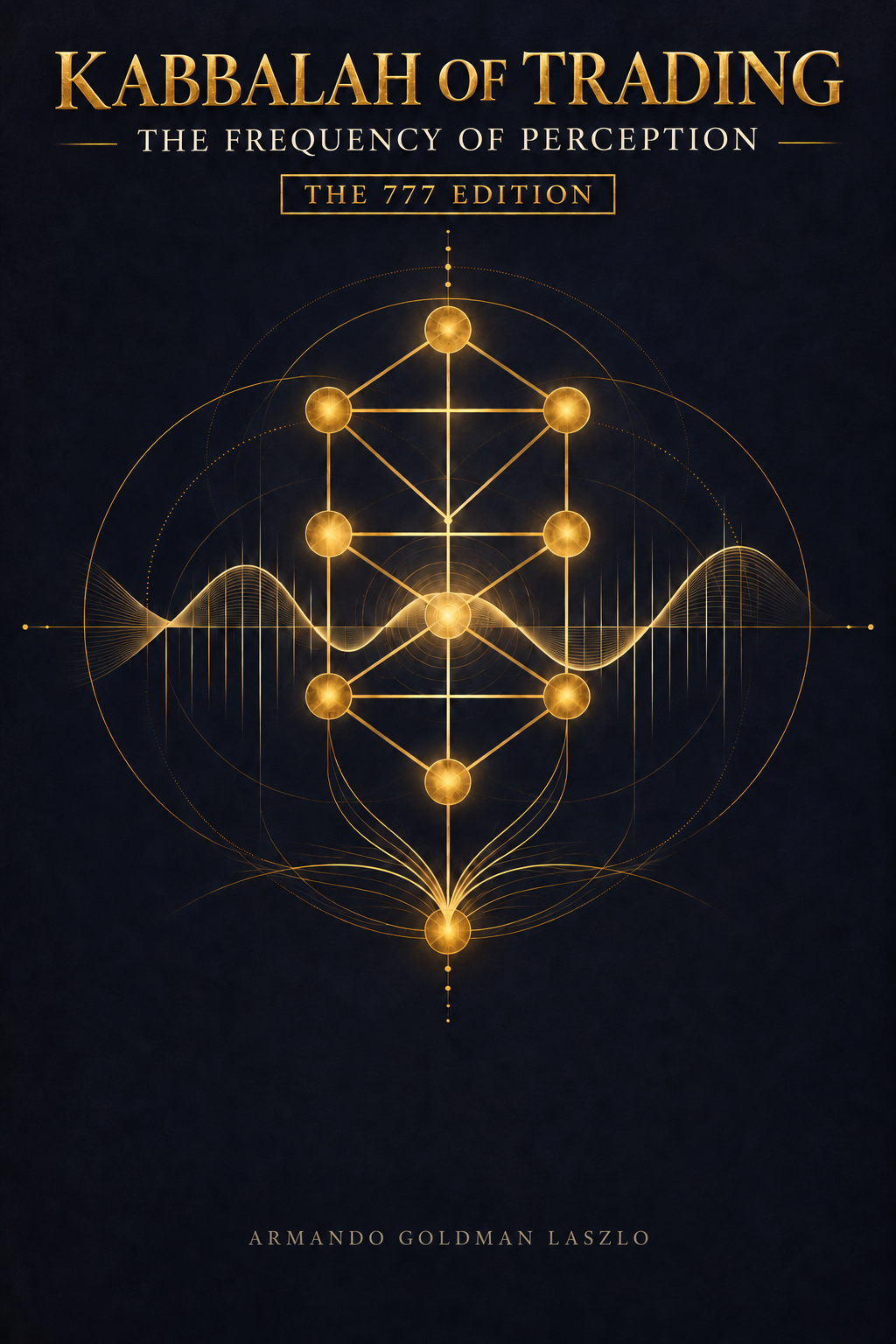
The 777 Edition
Kabbalah
of Trading
The Frequency of Perception
A reflective book about the observer behind the chart: attention, uncertainty, risk, symbolic language and the ordinary discipline of making a decision without pretending to know its outcome.
The 777 Edition is now live on Amazon in Kindle and paperback formats.
The central question
Who is looking at the chart?
Many trading mistakes begin before the indicator, the entry or the order. They begin with the state of the person looking: fear narrows the field, certainty edits the evidence and urgency turns a scenario into a command.
This book uses Kabbalistic and esoteric imagery as a literary frame for a contemporary inquiry into trading psychology. It does not claim that rituals predict prices or that a spiritual state can remove uncertainty. It asks what becomes visible when the observer is included in the analysis.
A practical reading
From the opening
There are evenings when a person closes a platform and continues trading in the kitchen. The numbers have gone, but an argument remains.
This book begins with that unfinished argument. It follows the wish to see more clearly, through the mind that sees and the markets that refuse to be reduced to its wishes.
We use frequency as a governing metaphor for that relationship with events. Its practical tests are concrete: Can the reader preserve disconfirming evidence? Explain a position size? Distinguish a sensation from a forecast? End a session and return to another human being with some attention left?
A clear boundary
Symbolism is not a signal.
Kabbalah is a diverse Jewish mystical tradition with a religious and intellectual life beyond the analogies made here. Christian Cabala and Hermetic Qabalah belong to related but distinct histories. This book states its borrowing openly and keeps the market framework contemporary.
The fictional scenes and examples are for study, not proof of performance. Risk budgets and timing choices are assumptions for reflection. A stop order does not guarantee a loss ceiling, and no spiritual vocabulary removes the need for evidence, sizing and the possibility of being wrong.
The page is educational and literary. It is not financial, investment, tax or legal advice, and it does not promise profits or prediction.