Armando GoldmanTrading / Markets / Reference
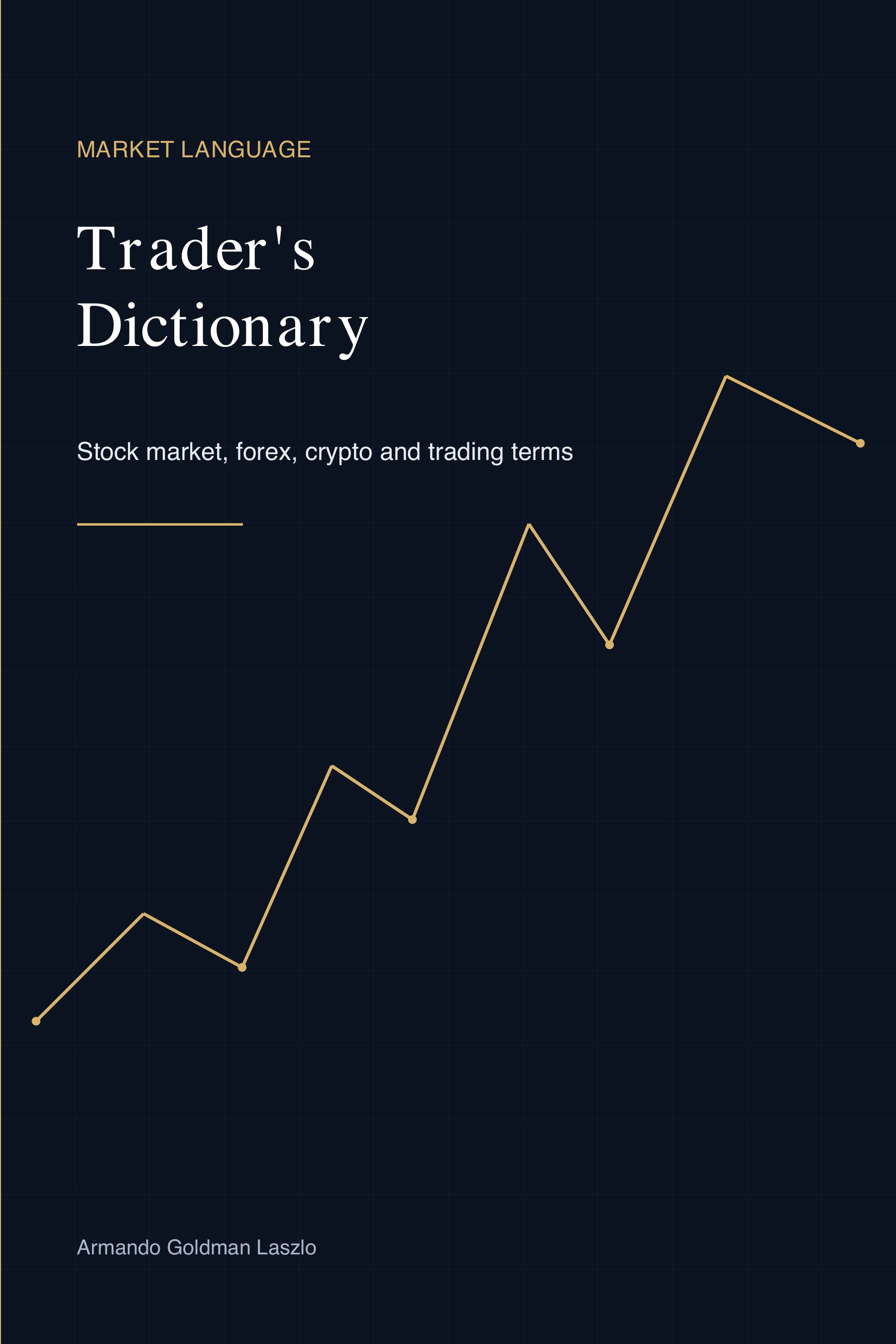
Trader's Dictionary: The Complete Guide to Stock Market, Forex, Crypto, and Trading Terms book cover

A practical market reference

Trader's
Dictionary

The Complete Guide to Stock Market, Forex, Crypto and Trading Terms

Markets have a language of their own. This reference explains the terms behind orders, liquidity, volatility, leverage, margin, risk, derivatives and trading psychology in plain English.

Kindle and paperback editions available on Amazon · ASIN B0HM3GHC89

Trading terms explained with examples

Jump to orders and execution, risk and leverage, or forex and crypto.

Orders and execution

Bid–ask spread
The difference between the highest displayed bid and lowest displayed ask in a quote. A bid of $49.98 and an ask of $50.02 imply a $0.04 spread.
Slippage
The difference between an expected execution price and the actual fill. If you expected to buy at $50 and filled at $50.08, the difference is $0.08 per share.
Limit order
An order to buy at a specified price or lower, or sell at that price or higher. A buy limit at $50 may go unfilled even if a trade prints at $50, because other orders can have priority.

Risk and leverage

Drawdown
A decline from a prior peak. An account falling from $10,000 to $8,000 is down 20% from its peak and needs a 25% gain to return to it.
Leverage
Exposure larger than the capital supporting it. With $5,000 of exposure backed by $1,000, a 1% price move changes position value by $50 before costs.
Liquidity
How readily an order can be executed with limited price impact. A market that absorbs 100 shares easily may move sharply when asked to absorb 10,000.

Forex and crypto

Pip
A conventional unit of exchange-rate movement. In EUR/USD, a move from 1.0800 to 1.0801 is one pip.
Funding rate
A rate used to calculate periodic payments between sides of many perpetual futures markets. Who pays and when depends on the venue's rules.
Liquidation
Forced reduction or closure of a leveraged position under a venue's margin rules. A venue may begin closing a position when its collateral falls below the maintenance requirement.

Why this reference exists

Define the term before it defines the decision.

Trading language can compress a large assumption into a small word. “Liquidity,” “margin,” “breakout,” “risk” and “value” may sound familiar while carrying different consequences in different contexts.

Trader's Dictionary is designed as a working reference: look up a term, read a clear definition, see it in context, connect it to related concepts and notice the mistake that often follows when the word is used too casually.

A clearer vocabulary does not remove uncertainty. It makes uncertainty easier to see.

Inside the book

Market foundationsAssets, exchanges, sessions, price, volume, spreads and the language of participation.
Orders & executionMarket, limit, stop, slippage, queue, fills, routing and implementation shortfall.
Liquidity & market dataBid, ask, depth, imbalance, volatility, order flow and the limits of displayed information.
Technical & macro termsTrends, ranges, indicators, rates, inflation, policy, growth and the data that moves narratives.
Options & derivativesFutures, forwards, calls, puts, Greeks, expiration, basis, funding and leverage.
Risk & psychologyDrawdown, position size, expectancy, bias, FOMO, revenge trading and decision quality.
Stockmarket terms
Forexand currency language
Cryptoand digital assets
Riskand execution concepts

Built for real readers

Useful at the desk, not just on the shelf.

Use it when a chart, research note, platform message or trading conversation introduces a term that deserves a second look. The aim is not to turn vocabulary into a prediction. It is to help the reader ask better questions about evidence, assumptions, timing and risk.

Educational reference only. The book does not provide personalized investment advice, trading signals or a promise of profits. Market decisions involve uncertainty and loss.

Common questions

Is this only for beginners?

No. The definitions are accessible to newer readers, while the cross-links between execution, liquidity, derivatives and risk make it useful as a refresher for active traders.

What markets does it cover?

Stock market, forex, crypto, options, futures and the macro language that connects market conditions to trading decisions.

Is it a strategy book?

No. It is a terminology and decision-language reference. It helps explain concepts; it does not promise a winning system.

Where can I get it?

The Kindle and paperback editions are available on Amazon through the listing below.